
IMPRS Leipzig School Of Human Origins PhD Programme 2027 in Germany | Fully Funded — Max Planck Institute for Evolutionary Anthropology and Leipzig University
Few research questions span as many disciplines as human origins, and Leipzig built a doctoral school specifically to train researchers who can move between genetics, archaeology, and primate behavior without missing a beat.
About the Scholarship
The International Max Planck Research School known as the Leipzig School of Human Origins is a joint PhD programme between the Max Planck Institute for Evolutionary Anthropology and Leipzig University. The three-year programme trains graduates across anthropology, archaeology, biology, biochemistry, bioinformatics, computational biology, evolutionary genetics, human behavioral ecology, paleoanthropology, primatology, and psychology, all connected through the shared question of human evolutionary history.
Scholarship Benefits
Doctoral candidates receive fellowship support covering their full three-year programme.
- Fellowship funding provided either by the Max Planck Institute for Evolutionary Anthropology or Leipzig University
- Access to world-class genetic sequencing and paleoanthropological research facilities
- A genuinely interdisciplinary training environment spanning multiple departments and methods
- Support for highly motivated, excellent young scientists from around the world
Eligibility Criteria
Applicants need a strong Master’s degree in a field connected to human evolution, such as biological anthropology, archaeology, genetics, primatology, or psychology. The programme is explicitly open to international students, and English is the working language throughout, so no German proficiency is required for admission.
Fields of Study Covered
Research spans paleoanthropology, ancient and modern human genetics, primate behavior and cognition, archaeology, and the computational methods used to study human evolutionary history.
Required Documents
- Online application through the IMPRS portal
- Master’s degree certificate and transcripts
- CV detailing relevant research experience
- Statement of research interests connecting to human origins research
- Letters of recommendation
How to Apply (Step-by-Step)
1. Review the research groups across the Max Planck Institute for Evolutionary Anthropology and Leipzig University.
2. Prepare transcripts, a CV, and a statement of research interests tied to human evolution.
3. Secure letters of recommendation from academic referees.
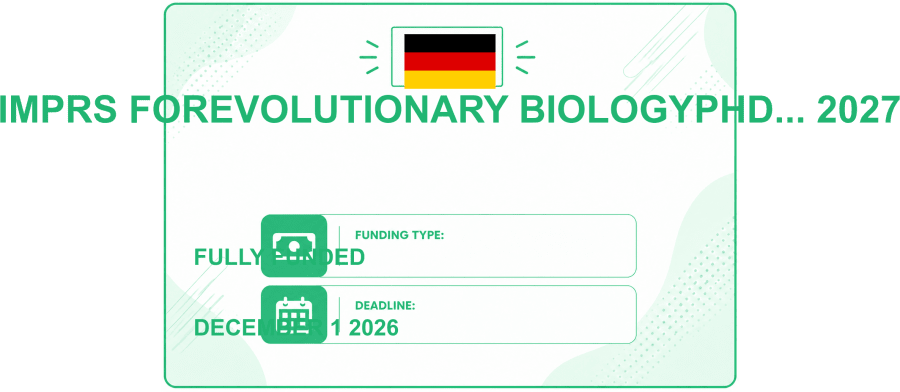
4. Submit the complete application by the December 1 deadline.
5. Attend an interview if shortlisted by the admissions committee.
6. Join the incoming cohort and begin the three-year structured doctoral programme.
Selection Process
The admissions committee evaluates academic strength in a relevant discipline, genuine motivation for interdisciplinary human origins research, and fit with specific research groups spanning genetics, archaeology, or primatology.
Tips to Improve Your Chances
Applicants who can clearly connect prior coursework or thesis work to a specific thread of human origins research, whether genetics, fossil evidence, or primate behavior, tend to stand out from general biology or anthropology applicants. Demonstrating comfort working across disciplinary boundaries, since the programme explicitly blends genetics, archaeology, and behavioral science, reflects exactly what this school values. Students interested in other Max Planck life-science doctoral programmes may also want to review the International Max Planck Research School for Evolutionary Biology PhD Programme for comparison.
Frequently Asked Questions
Is a background specifically in genetics required to apply?
No, applicants from anthropology, archaeology, primatology, or psychology backgrounds are equally welcome, as long as their research interests connect to human evolutionary questions.
How is funding structured for doctoral candidates?
Fellowships come either from the Max Planck Institute for Evolutionary Anthropology or Leipzig University, or in some cases students bring their own external funding.
Is German language proficiency required?
No, the entire programme operates in English, so German is not required for admission or for completing the doctorate.
How long does the PhD typically take?
The programme is designed to be completed in three to four years, consistent with other structured Max Planck Research Schools.
Does the programme include fieldwork opportunities?
Yes, depending on the specific research project, fieldwork at archaeological or primate research sites can be part of the doctoral research.
What career paths follow this PhD?
Graduates often continue into postdoctoral research in anthropology or genetics, academic positions, or roles with natural history museums and research institutions worldwide.
Can applicants with a strictly biology-focused background apply, with no anthropology coursework?
Yes, strong biology, genetics, or biochemistry backgrounds are welcome, as long as the research proposal connects clearly to a human evolution question within one of the programme’s participating research groups.
Does the programme offer training in ancient DNA analysis specifically?
Yes, given the Max Planck Institute for Evolutionary Anthropology’s leading role in ancient DNA research, several research groups focus specifically on paleogenomics methods.
Is there support for international students relocating to Leipzig?


Both the Max Planck Institute and Leipzig University provide general onboarding support, including guidance on housing and visa matters for incoming doctoral students.